
Hancock County Arrest Warrants Explained
An arrest warrant is a court's command to take someone into custody. Tennessee Rule 4 supplies the framework, and it rests on probable cause: stated facts tying a person to an alleged offense. The state's blank forms walk through the complaint, the judicial review, the choice of process, and the officer's return. Hancock County publishes no local online warrant form, and no single unit handles process for every court. On the complaint form itself, a citation, a criminal summons, and an arrest warrant are separate boxes. So ask the issuing court which one was used. Assuming every charge started with a warrant is a mistake.
Rule 4 and a Hancock County Arrest
Rule 4 lays out a simple sequence. It starts with an affidavit of complaint and the supporting facts. A judicial official then reviews probable cause and may issue an arrest warrant, or a criminal summons where that is allowed. The Hancock court keeps the docket record. An authorized law-enforcement agency takes the process for service. The state court rules index collects Rule 4 with the related criminal procedure rules.
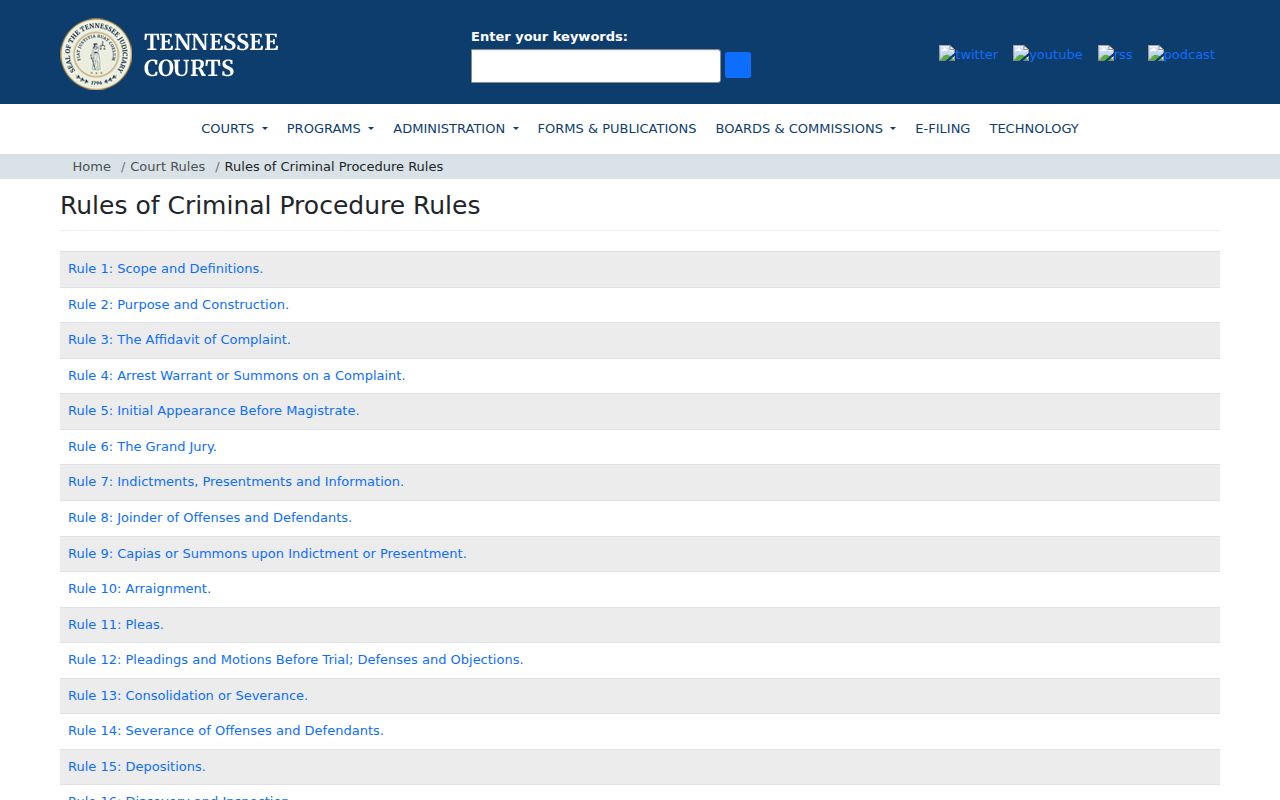
The index is statewide guidance, not a Hancock case search.
Inside a Hancock County Arrest Warrant
Tennessee's blank general-sessions warrant form packs in the essentials. It has the court, the state-control number, the case number, the charge, the command, bond fields, the issuing signature, and a return block for the officer. Related complaint papers can show the alleged facts and the probable-cause call. Treat it as a field guide only. It holds no Hancock County case data.
| Case number | Hancock format not published; use the official case identifier when requesting a file. |
|---|---|
| Named person | Identifies the court file; private descriptor fields should not be copied into public material. |
| Charge / offense | States the alleged offense and may cite a Tennessee code section. |
| Issuing court | Identifies the court or authorized official whose order controls the next step. |
| Bond / terms | May list conditions; no Hancock-wide bond amount is published. |
| Issue and return dates | Record issuance and any officer return; ask for current docket status. |
Hancock County Arrest Warrant Affidavit Fields
The complaint form captures the alleged date and location, the county, the offense section, the essential facts, and the source of the information. It records the affiant, the oath, and the judicial probable-cause decision. The process choices are separated too: citation, arrest without warrant, arrest warrant, and summons. That layout helps a clerk pull the right paper when a reader has only a notice in hand. The personal fields are not an invitation to copy or publish someone's identifiers. Request only the public record your case question needs. Hancock County clerks can work from those same field distinctions.
Serving Arrest Warrants in Hancock County
The Hancock Sheriff's Department is the county's law-enforcement contact at 265 New Jail Street. The jail sits in the same building. But the department posts no warrant-unit extension, no service assignment chart, and no surrender hours. Sneedville Police appears in the TBI listing at 292 New Jail Street, reachable at (423) 733-2250. If a municipal warrant is involved, ask the city or the court whether that office holds or serves it. A warrant return may note service, the date, the officer, the agency, or a not-found result. After an arrest can come an initial appearance and a bond decision. Hancock County promises neither a fixed outcome nor one agency for every case.
Hancock County Service Roles
Issuing and serving are different jobs. A judge or authorized official issues court process. An officer or agency serves it. The sheriff is the main public county contact, while Sneedville Police keeps its own directory entry. State agencies may serve process within their authority, and federal matters run through a separate court and service system. For a Hancock County case, call the sheriff at (423) 733-2250 or 2249, and the Circuit Court Clerk at (423) 733-2954. Neither public page assigns every warrant to one service unit. The Sheriff's Department directory lists its public contacts, and the AOC county court page identifies the Circuit and Criminal Court grouping. Both are routing sources, not an online arrest-warrant query.
Hancock County Arrest vs Summons and Bench Warrants
Tennessee forms keep the process types distinct. An arrest warrant directs an officer to arrest under the order. A criminal summons directs a person to appear instead. A bench warrant or capias usually traces back to a missed court duty or other court process. Before deciding what a paper requires in Hancock County, confirm the document title and the issuing court.
| Feature | Arrest Warrant | Summons | Bench Warrant |
|---|---|---|---|
| What it orders | Arrest under the written command | Appear at the stated court date | Bring a person before the court |
| Basis | Probable cause | Process allowed by Rule 4 | Missed obligation or other court action |
| Who issues it | Judge or authorized official | Court or official under the rule | Issuing court or judicial official |
| How to respond | Confirm status, bond, and appearance | Attend as directed | Ask about recall, appearance, or counsel |
Why the Officer Return Matters
The original warrant shows what was ordered at issuance. The officer-return block tells you what happened after: service, or a not-found outcome. A later docket entry may show a recall, a quash, or some other action. Requesting only a scan of the first page can miss the update that shows current status. Ask the Circuit Clerk or the issuing court for the latest docket entry along with any return. If the file sits outside Circuit or Criminal Court in Hancock County, ask for a referral to the court that holds it.
Hancock County Arrest Warrant: Next Steps
Start with the court that issued the warrant. Ask the clerk whether the docket still lists it as active, and get the next court date. Ask about bond too, plus where you should report. A lawyer can weigh a voluntary appearance against a bond posting, or a motion to recall or quash, based on the facts of the case. The clerk will route records but cannot give legal advice. One caution for Hancock County: its public pages describe no walk-in surrender procedure, same-day recall, bond window, or safe-harbor program. So do not show up at the sheriff's office or courthouse on a guess. Get location and reporting instructions from the issuing court first.
Important: Speak with counsel and confirm the court’s instructions before appearing; a valid arrest warrant can lead to custody.
Hancock County Arrest Warrant Status and Next Date
Once a warrant is served, a bond is posted, or a judge recalls it, the case in Hancock County keeps moving on its own track. Ask the clerk how each step shows on the docket and when to look again. A bond can get someone released. It does not end the case. Even a recalled warrant can leave an appearance date, a fine, or probation conditions behind. Keep your receipt and next-date notice, ask the clerk for copies, and lean on the court or your lawyer for advice about your specific case; the sheriff's contact page is not a status certificate.